IPL vs Laser Hair Removal: Which Is Better?
The difference between IPL and laser hair removal, who they’re suitable for and how to decide which treatment may be best for you.
IPL vs Laser Hair Removal: Which Is Better?
If you’re considering long-term hair reduction, you may have come across both IPL and laser hair removal and wondered what the difference actually is — and, more importantly, which one is better?
It’s a question I get asked quite regularly.
I offer professional IPL hair reduction at HAZE Beauty, but I’m not going to tell you that IPL is automatically the better option simply because it’s the treatment I offer.
The truth is, there isn’t one treatment that’s best for everybody.
Your skin tone, hair colour, the area being treated and even the equipment being used can all affect which option may be more suitable.
So let’s look at the differences.
What is IPL hair removal?
IPL stands for Intense Pulsed Light.
Although IPL and laser are often grouped together, they aren’t technically the same technology.
IPL uses a broad spectrum of light, meaning several wavelengths of light are delivered into the skin. Laser technology uses a more concentrated, specific wavelength.
For hair reduction, the aim is for the light to be absorbed by the melanin (pigment) within the hair. That light energy is converted into heat, which damages the structures responsible for hair growth.
Over a course of treatments, this can result in the hair becoming finer, growing more slowly and significantly reducing in amount.
You’ll notice I use the term hair reduction rather than permanent hair removal. That’s intentional. Neither IPL nor laser should be presented as a guarantee that you’ll never see another hair again, and maintenance treatments may sometimes be needed.
How is laser hair removal different?
Laser hair removal works on a similar principle — using light energy to target pigment within the hair — but the way the light is delivered is different.
A laser generally uses a specific wavelength of concentrated light, allowing it to target the hair follicle more precisely.
And this is where it’s important not to think of laser as one single treatment.
Different laser systems use different wavelengths. Examples include Alexandrite, diode and Nd:YAG lasers, and the suitability of each can vary according to the client’s skin and hair.
So when comparing IPL with laser, the question isn’t really as simple as:
“Which is better, IPL or laser?”
A better question is:
“Which technology is most appropriate for my skin and hair?”
Is laser better for darker skin tones?
This is one area where certain laser systems can have an important advantage.
Both IPL and laser hair reduction rely on being able to target pigment in the hair while protecting the surrounding skin.
With darker skin, there is naturally more melanin within the skin itself. This means there can be a greater risk of the skin absorbing some of the light energy rather than the hair being the main target.
That can increase the risk of complications such as burns or changes in pigmentation if inappropriate equipment or settings are used.
Certain laser wavelengths — particularly long-pulsed Nd:YAG (1064 nm) — can be used for hair reduction on darker skin because of the way that wavelength interacts with melanin and penetrates the skin.
The American Academy of Dermatology notes that laser hair removal can be performed across different skin colours when appropriate technology and expertise are used, while also highlighting that darker skin has a greater risk of burns and pigmentation changes from laser treatments.
So if someone came to me with a skin tone that wasn’t suitable for the IPL system I use at HAZE Beauty, I wouldn’t try to treat them simply because I wanted their business.
I’d explain why I didn’t think IPL was the safest choice and recommend that they look for a reputable clinic offering technology more appropriate for their skin.
For me, client safety has to come before making a sale.
What hair colours respond best?
This is another area where expectations need to be realistic.
Because these treatments rely heavily on pigment within the hair, darker hair generally provides a better target for light-based hair reduction.
Very blonde, white, grey and some red hair may contain insufficient melanin to respond effectively.
This is why a proper consultation is so important.
Two people could want exactly the same area treated but have completely different skin and hair combinations — and therefore shouldn’t automatically receive exactly the same treatment plan.
So, is laser more powerful than IPL?
Generally, professional laser systems can deliver more concentrated and targeted energy because they use a specific wavelength, whereas IPL uses a broader spectrum of light.
But “more powerful” doesn’t automatically mean “better for you.”
The effectiveness and safety of either treatment depend on several things:
- your skin tone
- your hair colour and thickness
- the area being treated
- the particular IPL or laser device
- the settings being used
- your medical history and medications
- sun exposure and tanning
- the skill, knowledge and training of the person treating you
- following the recommended treatment schedule and aftercare
The equipment matters, but so does the person operating it.
Does IPL work?
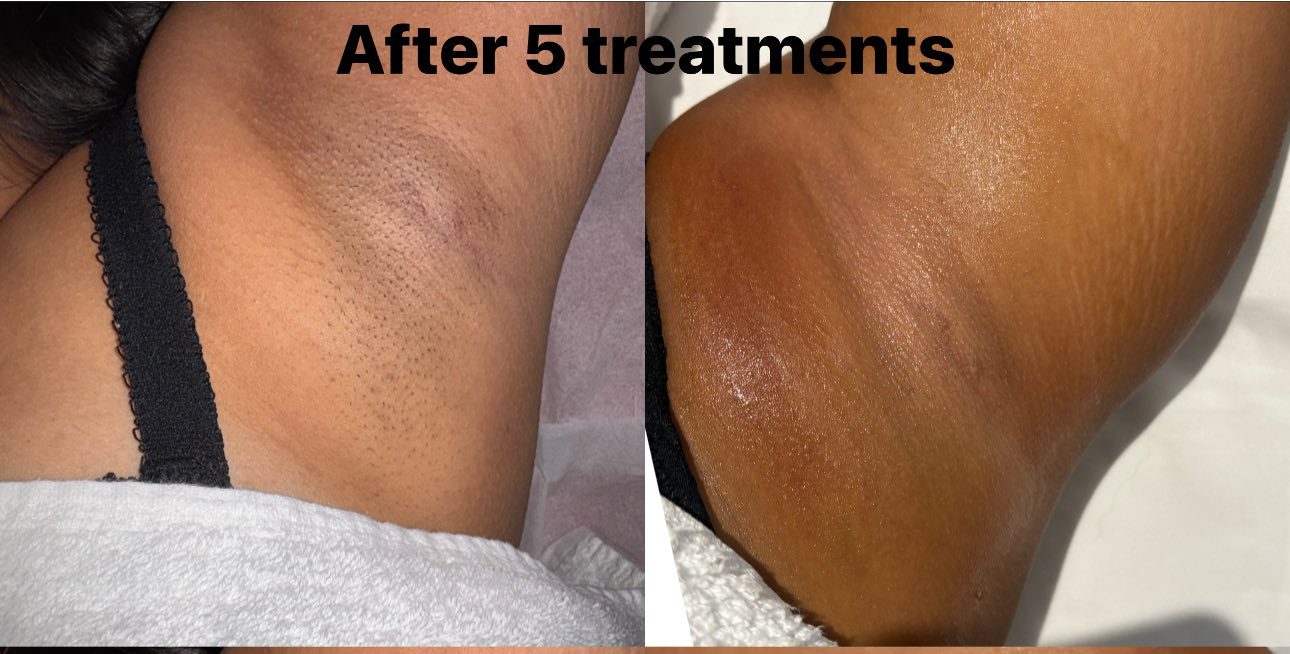
Yes — on an appropriate client, professional IPL can achieve excellent long-term hair reduction.
IPL can be particularly effective when there is a good contrast between the colour of the skin and darker hair.
But I also think it’s important to differentiate between professional IPL systems and home IPL devices.
They’re all described as IPL, but that doesn’t mean they’re identical in terms of energy delivery, settings, treatment protocols or suitability. So someone’s experience with a home IPL device isn’t necessarily an indication of what they can expect from a professional treatment.
Which requires more treatments?
This isn’t something I’d give you an exact answer to without assessing you first.
Hair grows in cycles, and light-based hair reduction is most effective when hairs are in the appropriate active growth stage.
That’s why you need a course of treatments rather than one appointment.
The number you’ll need varies between individuals and can also depend on the area being treated, hormones, hair characteristics and the technology being used.
At HAZE Beauty, I generally advise clients that a course of approximately 8–12 IPL treatments may be required for hair reduction, but this is a guide rather than a guarantee.
What about pain?
Neither treatment should simply be sold as completely painless.
How it feels depends on the equipment, settings, treatment area and your individual sensitivity.
With IPL, clients commonly describe a quick hot or snapping sensation as the pulse is delivered.
What I don’t believe in is the idea that:
“If it hurts more, it must be working better.”
Effective treatment is about using safe and appropriate settings, not seeing how much discomfort someone can tolerate.
So… IPL or laser: which is better?
My answer is probably slightly less exciting than you were hoping for:
It depends.
For someone with suitable skin and dark hair, professional IPL can be a very effective option for long-term hair reduction.
For another person — particularly someone with a darker skin tone — an appropriate laser system may be the safer or more suitable choice.
And for someone with very light, grey, white or certain red hair, neither may give them the results they’re hoping for.
That’s why I don’t believe you should choose a treatment simply because one clinic tells you their machine is “better”.
Choose a practitioner who will assess you, explain the limitations as well as the benefits, be realistic about expected results and, most importantly, be prepared to tell you when their treatment isn’t suitable.
Considering IPL hair reduction in Bournemouth?
At HAZE Beauty, I offer professional IPL hair reduction from my private, ladies-only home salon in Bournemouth.
Every IPL client starts with a consultation and patch test before treatment. This gives me the opportunity to assess your skin and hair, discuss your medical history and expectations, explain how the treatment works and make sure IPL is an appropriate option for you.
And if I don’t believe IPL is right for you, I’ll tell you.
I’d much rather lose a booking than provide a treatment I don’t believe is suitable or safe.